📘 1. Introduction
Sharjah’s remarkable Faya Palaeolandscape has been officially inscribed on UNESCO’s World Heritage List, becoming the UAE’s second national World Heritage site—and the only one added in the Arab world in 2025. Nestled in the central region of Sharjah, this extraordinary cultural landscape reveals over 210,000 years of early human occupation in one of the world’s most challenging environments. It stands out not only for its geological features but also as a rare case of prehistoric settlement in arid desert lands, disrupting old theories that the Arabian Peninsula was merely a migratory corridor.
This 4,000‑word deep dive navigates the past and present of the Faya Palaeolandscape, examining its geological backbone, archaeological richness, research collaborations, inscription journey, conservation frameworks, and wider scientific and socio-economic impacts. As one of the most significant archaeological finds in the region, the Faya Palaeolandscape has opened up an entirely new window into the prehistory of the Arabian Peninsula and the larger global narrative of early human evolution.
Moreover, its addition to the UNESCO World Heritage List affirms Sharjah’s role as a steward of cultural and historical heritage in the region. The site continues to inspire awe and wonder not only among scientists and researchers but also among tourists, historians, and citizens eager to explore the roots of human civilization.
🌋 2. Geological & Geographical Profile
2.1 Location & Setting
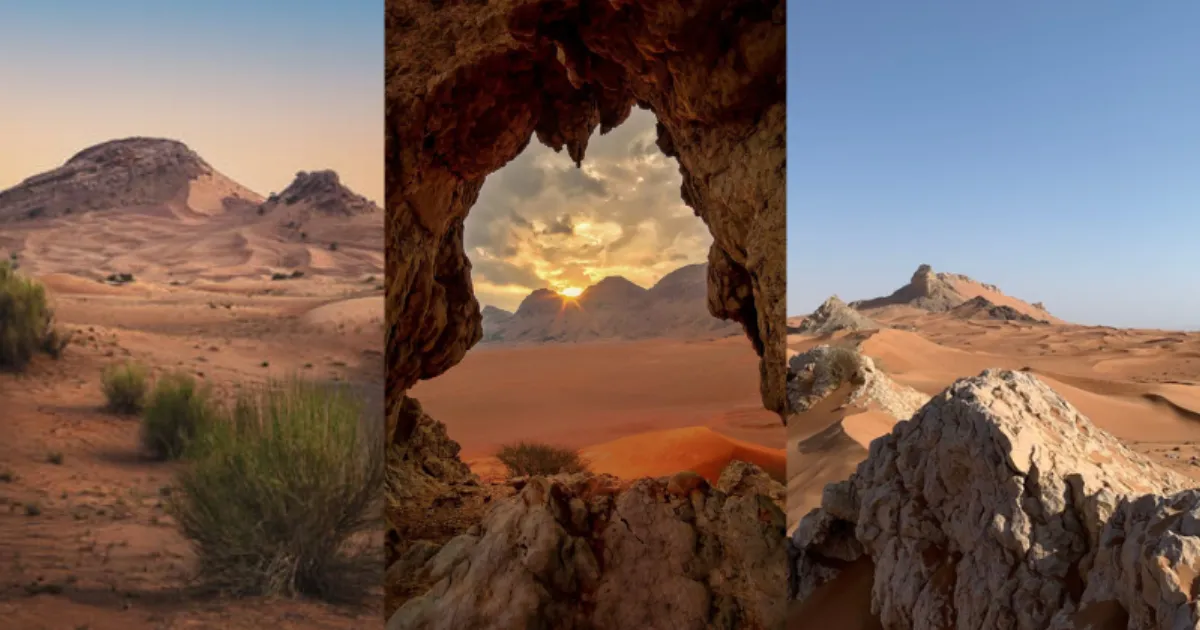
Located approximately 50‑55 km east of Sharjah city, the Faya Palaeolandscape centres on the Jebel Faya limestone escarpment, a natural anticline that stretches about 20 km from northeast to southwest. Its positioning between the coastal plains and the Hajar Mountains provided a unique ecological zone that was suitable for intermittent human settlement throughout the Pleistocene and early Holocene periods.
2.2 Formation & Terrain
The terrain is geologically rich and diverse. The landscape comprises three main geological layers: ophiolite (~93 Ma), conglomerates (76–68 Ma), and limestone (74–66 Ma). These ancient rock formations were uplifted by the complex collision of the Arabian and Eurasian tectonic plates, creating a dynamic environment that exposed flint nodules, which early humans exploited to manufacture tools. These layers provide crucial information about the Earth’s evolutionary timeline and environmental changes.
2.3 Natural Water Systems
Jebel Faya’s structure contributed to the formation of natural aquifers and seasonal wadis. These geological features created intermittent water sources, allowing human populations to establish temporary settlements during periods of increased rainfall. Fossil water beds and palaeolake deposits remain visible to this day, offering evidence of former water abundance in what is now a hyper-arid region. These water systems were crucial to early human survival in the harsh desert climate.
2.4 Climate Role
Climatic fluctuations played a significant role in the formation and habitability of the Faya Palaeolandscape. During wet pluvial phases of the Pleistocene era, the area became hospitable for flora, fauna, and early humans. Such periods coincided with the retreat of desert conditions, turning Faya into a lush and resource-rich zone. These changes made the site a recurring refuge for human populations navigating environmental extremes.

🗿 3. Archaeological Discoveries & Significance
3.1 Continuous Human Presence
Archaeological excavations spanning more than three decades have revealed a rich tapestry of human occupation. Sites like FAY‑NE1 and Jebel Faya have yielded 18 well-preserved archaeological layers, each representing a different period of human activity. This stratified evidence illustrates a near-continuous record from the Early Middle Palaeolithic (~210,000 BP) to the Neolithic (~5,000 BP). Such continuity is rare in desert environments and testifies to the resilience and adaptability of early humans.
3.2 Stone Tool Innovation
Among the most remarkable discoveries are stone tools that exhibit sophisticated manufacturing techniques. Dated to 80,000 years ago, these tools demonstrate bidirectional flaking, a method that allowed early humans to shape sharp-edged tools from flint with remarkable precision. The technological complexity mirrors similar advancements seen in other parts of Africa and Central Sudan, thereby linking the Faya Palaeolandscape to broader trends in human innovation and adaptation.
3.3 Human Evolution Implications
The unique assemblages found in Faya challenge prevailing theories that early humans exited Africa solely via the Levantine route. Instead, the tools suggest that Homo sapiens may have taken a southern coastal path through Arabia. This lends credibility to the “Southern Dispersal Route” hypothesis and positions the Faya Palaeolandscape as a pivotal node in the story of human evolution and migration.
3.4 Stratigraphy & Dating
Cutting-edge dating methods, including single-grain optically stimulated luminescence (OSL), have provided precise age estimates for different sedimentary layers. This method allows researchers to accurately time the phases of occupation, supporting the narrative of episodic but repeated human presence that corresponds with climate data and resource availability.
3.5 Beyond Migration
Unlike earlier perceptions of Arabia as a mere passageway for human migration, the Faya Palaeolandscape reveals evidence of actual settlement and cultural development. This repositions the region as a cradle of civilization in its own right, with its contributions to the human journey across time.
🧑🔬 4. Principal Research Collaborations
4.1 Sharjah Archaeology Authority (SAA)
The Sharjah Archaeology Authority has been a cornerstone in the discovery, excavation, and preservation of the Faya Palaeolandscape. Their systematic research and collaboration with international experts have elevated the site to global prominence.
4.2 Academic Partnerships
Partnerships with the University of Tübingen and the University of Freiburg have played a crucial role in interpreting the archaeological finds. Oxford Brookes University contributed to climate and environmental reconstructions, offering a holistic view of past human life and natural settings in the region.

🏛️ 5. UNESCO Inscription Journey
5.1 Tentative Listing (2023)
The UAE’s Ministry of Culture and Youth formally added the Faya Palaeolandscape to its tentative list in 2023. This move signified the country’s acknowledgment of the site’s global importance and its commitment to preservation.
5.2 Nomination Form (2024)
A detailed nomination dossier was submitted in 2024, supported by a decade of robust scientific documentation, excavation records, environmental data, and community consultations. The comprehensive application highlighted the site’s Outstanding Universal Value (OUV).
5.3 47th WHC Session (July 2025)
At the World Heritage Committee’s 47th session in Paris, the Faya Palaeolandscape was officially inscribed as a UNESCO World Heritage Site. Sharjah became the only Arab entity to receive a listing in 2025, marking a milestone for regional heritage.
🛡️ 6. Conservation & Management
6.1 Legal Protection
The Faya Palaeolandscape enjoys protection under Sharjah’s Cultural Heritage Law No. 4 of 2020. This legal framework ensures the long-term conservation of both tangible and intangible heritage elements associated with the site.
6.2 2024–2030 Management Plan
A strategic management plan has been implemented, encompassing archaeological research, eco-tourism, community involvement, and visitor education. The roadmap outlines funding strategies, risk mitigation, and data-driven monitoring systems.
6.3 Visitor Infrastructure
Facilities near the site, especially the Mleiha Archaeological Centre, serve as gateways for public engagement. With over AED 250 million invested, the site features interactive exhibits, eco-lodging, guided tours, and research labs.
6.4 Scientific Monitoring
Ongoing climate studies, erosion monitoring, and archaeological surveys ensure that the Faya Palaeolandscape remains both a research hub and a living classroom for future generations.
🌍 7. Scientific & Cultural Impact
7.1 Challenging Out‑of‑Africa Narratives
The Faya Palaeolandscape significantly contributes to the ongoing debate about early human migration. Traditionally, scholars believed Homo sapiens exited Africa through the Levant. However, discoveries at Faya offer compelling evidence for an alternate southern route via the Arabian Peninsula. This challenges long-standing academic paradigms and encourages new models of early human dispersal, especially during periods of climatic favorability.
7.2 UAE’s Heritage Vision
The site reinforces the UAE’s vision of combining cultural preservation with knowledge production. It serves as a cornerstone in Sharjah’s broader efforts to integrate heritage into national identity, education, and international diplomacy. This focus enhances the emirate’s position as a global hub for history, science, and cultural exchange.

🌐 8. Tourism & Educational Opportunities
8.1 Eco‑tourism Development
The Sharjah government envisions the Faya Palaeolandscape as a pillar of sustainable tourism. Plans are underway to integrate desert camps, nature trails, and eco-lodges into the surrounding Mleiha region. These initiatives will help visitors experience the site’s prehistoric ambiance while promoting environmental conservation.
8.2 Educational Outreach
Educational institutions will play a vital role in unlocking Faya’s full potential. Curricula for schools and universities are being revised to include modules on Sharjah’s archaeology. Field trips, workshops, and digital platforms are planned to make the site’s findings accessible to the public, thus nurturing a new generation of culturally conscious citizens.
8.3 Cultural Diplomacy
With its international recognition, the Faya Palaeolandscape serves as a soft power asset for the UAE. It will host international conferences, foster academic exchanges, and offer residencies for global researchers. Such initiatives will enhance the country’s standing in the fields of science, culture, and diplomacy.
8.4 Sustainable Experience
All tourism and educational developments are designed with sustainability in mind. Controlled visitor flows, minimal-impact infrastructure, and guided educational sessions ensure the site remains undisturbed while being fully appreciated by local and international audiences.
🔗 External Links
- UNESCO Tentative List – Faya Palaeolandscape
- Gulf News Coverage – 210,000 Years of Human Settlement
- Khaleej Times Article – UNESCO Listing
- Mleiha Archaeological Centre Information
- Sharjah24 – Official Announcement
- The National News – Faya Palaeolandscape Recognition
Also Read: Nature Therapy Spots in the UAE You’ve Never Heard Of (2025 Guide to Hidden Serenity)