🛒 Introduction
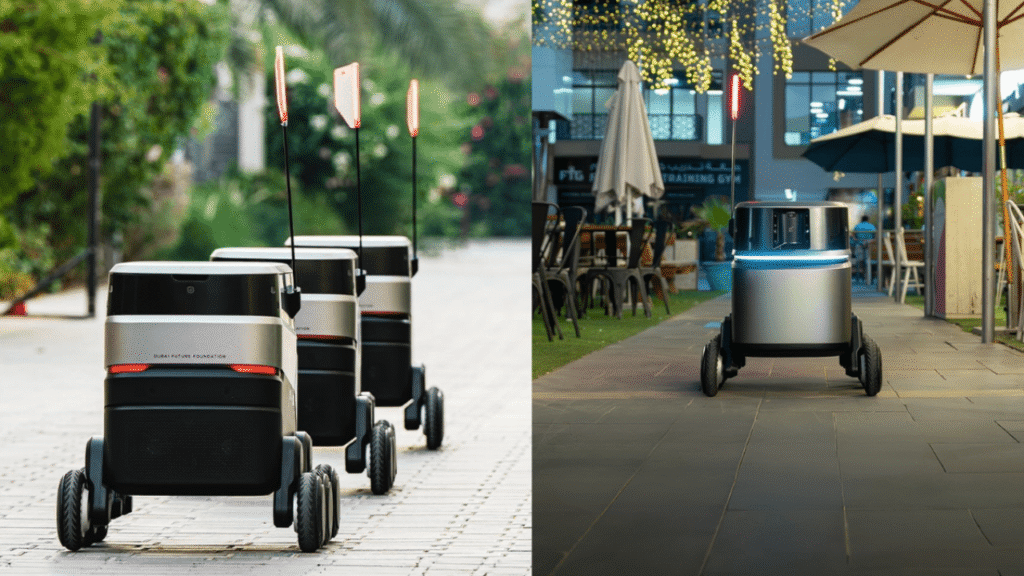
The UAE has long positioned itself as a hub of futuristic innovation, and in 2025, that future is walking down the sidewalk—or gliding across it. Food delivery robots are no longer a sci-fi fantasy; they’re part of daily life in select communities across Dubai, Abu Dhabi, and Sharjah.
From AI-powered buggies to autonomous carts, these robotic helpers are revolutionizing the food and grocery delivery experience. They reduce carbon footprints, streamline last-mile logistics, and introduce a touch of tech magic to mundane errands.
This comprehensive guide explores the current landscape of food delivery robots in the UAE, highlighting where they operate, how they work, their advantages, challenges, and future growth potential. If you’re curious about robotic grocery helpers in 2025, this article covers it all.
1️⃣ 📍 Where You Can Find Food Delivery Robots in the UAE
While still in their early stages, food delivery robots have been deployed in pilot projects and gated communities:
- Dubai Silicon Oasis (DSO): DEWA’s innovation arm launched delivery robots for internal deliveries
- Masdar City, Abu Dhabi: Hosts solar-powered robots for sustainable food delivery
- Jumeirah Lakes Towers (JLT): Features trials of AI-driven robotic delivery carts
Highlights:
- Community-based rollouts
- Controlled environments for testing
- 24/7 operation in some zones

2️⃣ 🚶♂️ How Do These Robots Work?
Food delivery robots use a combination of AI, GPS, LIDAR, and camera sensors to autonomously navigate sidewalks and small streets.
Typical Workflow:
- The customer places an order via the app
- Robot receives pickup and destination
- Navigates autonomously, avoiding pedestrians and obstacles
- Sends the customer a notification on arrival
These robots are designed to be secure, temperature-controlled, and tamper-proof.
3️⃣ 🧠 Tech Behind the Machines
Advanced hardware and software enable the smooth and intelligent operation of food delivery robots:
- AI algorithms for pathfinding and traffic analysis
- Edge computing for real-time decision-making
- Obstacle detection systems powered by LIDAR and vision sensors
- Cloud integration for fleet coordination and updates
UAE startups and global tech firms alike are participating in the robotics ecosystem.
4️⃣ 🥗 What Can Food Delivery Robots Deliver?
Food delivery robots in the UAE are currently optimized for:
- Grocery bags (up to 10kg)
- Prepared meals from local restaurants
- Pharmacy items
- Coffee and quick bites from kiosks
These bots are often seen in residential neighborhoods and business parks.

5️⃣ ⚙️ Benefits of Using Food Delivery Robots
There are numerous advantages to using food delivery robots:
- Contactless and safe
- Reduced delivery costs for businesses
- Eco-friendly with electric or solar power
- Operate during off-peak and night hours
Consumers enjoy the novelty, while businesses benefit from consistent logistics.
6️⃣ 💼 Who Is Behind These Technologies?
Several companies are pioneering food delivery robots in the UAE:
- Talabat partnered with Cartken robots in Dubai Silicon Oasis
- Clevon trials in Masdar City
- Neolix and Yandex exploring UAE entry
Support also comes from government initiatives in smart city development and logistics tech zones.
7️⃣ 🏠 How to Receive a Delivery From a Robot
Food delivery robots make the experience easy:
- Place an order through a partnered app (e.g., Talabat)
- Choose “robot delivery” if available in your area
- Receive real-time updates on the robot’s location
- Enter a secure code or use the app to unlock the robot upon arrival
Great for quick deliveries in high-density areas.

8️⃣ 🧼 Hygiene and Safety Protocols
In the post-pandemic UAE, safety and hygiene remain top priorities:
- Food delivery robots are sanitized regularly
- Use UV lights or anti-microbial surfaces
- Requires no human interaction for hand-off
This makes them an ideal solution for health-conscious users.
9️⃣ 🌍 Environmental Impact
Many food delivery robots are fully electric or solar-powered. Their benefits include:
- Zero tailpipe emissions
- Minimal noise pollution
- Less road congestion
In eco-forward zones like Masdar City, these bots align with the UAE’s net-zero goals.
🔟 🚧 Limitations and Challenges
Despite the promise, food delivery robots face several hurdles:
- Limited coverage (still in pilot phase)
- Speed restrictions (~5km/h)
- Difficulty with stairs and uneven pavements
- Licensing and regulatory uncertainty
The UAE is actively addressing these issues to scale operations.
1️⃣1️⃣ 🔄 Integration With Existing Delivery Ecosystems
Instead of replacing humans, food delivery robots are complementing existing fleets:
- Used for last-mile delivery
- Improve efficiency during peak hours
- Reduce human courier fatigue
Major brands are adopting a hybrid approach combining human and robotic delivery.

1️⃣2️⃣ 📦 User Feedback and Satisfaction
So far, residents report high satisfaction with food delivery robots:
- Timely deliveries
- Interactive tracking features
- Novelty and convenience
Some early adopters have even shared their experiences on TikTok and Instagram, further driving curiosity.
1️⃣3️⃣ 🏙️ Role in Smart City Vision
Food delivery robots are part of a broader smart city framework in the UAE:
- Integrated with IoT infrastructure
- Use smart traffic systems
- Support data collection for urban planning
This makes them a cornerstone of the country’s digital transformation.

1️⃣4️⃣ 📈 Market Potential and Investment
Investors see strong potential in food delivery robots:
- Growth in last-mile logistics startups
- Retail chains investing in robot delivery partnerships
- Government support via grants and smart mobility zones
Expect more funding and M&A activity in this space through 2025.
1️⃣5️⃣ 🔮 What’s Next for Food Delivery Robots in the UAE?
The roadmap for food delivery robots in the UAE includes:
- Expansion to public parks, malls, and metro stations
- AI voice assistance and multilingual interfaces
- Partnerships with the healthcare and elderly care sectors
Shortly, they could even deliver groceries via aerial drones or hybrid carts.

✅ Conclusion
As the UAE races ahead in its mission to become a leader in smart city living, food delivery robots are proving to be more than a novelty. They represent a transformative shift in how we receive goods, offering efficiency, safety, and futuristic convenience.
In 2025, food delivery robots will deliver real results. While the technology is still growing, its foundations are strong. Businesses are adapting, residents are curious, and the government is investing.
Whether you’re a tech enthusiast or just tired of waiting for couriers, the rise of food delivery robots signals that your groceries might soon be rolling up to your door—on six wheels and with zero emissions.
So next time you hear a soft whirr outside your home in Dubai or Abu Dhabi, don’t be surprised. It could be your groceries, delivered by one of the many food delivery robots reshaping everyday life in the UAE.
🌐 External Links
- Talabat Delivery Robot Program
- Masdar City Smart Mobility
- Dubai Future Foundation
- RTA Smart Mobility Strategy
- UAE Robotics and AI Association
Also Read: Mixed-Reality Film Festival: 15 Jaw-Dropping Highlights from the UAE’s First AR/VR Cinema Experience